Material Safety Data Sheet—Perfect Plank
Date of Preparation—26 January 2010
Section
One: Chemical Product and Company Identification
Product and Chemical Name:
Perfect Plank HMIS
H 1 F1 R 0 PPE Sec 8
Chemical Family: Cellulose
CAS Number: 9004-34-6
Other Designations: Not
applicable
General Use:
Not applicable
Manufacturer:
Perfect Plank Company, Post Office Box 511, Oroville, CA 95965.
Phone: 530-533-7606. FAX: 530-533-2814.
Hours of Operation: 7:30 a.m. to 4 p.m. Monday to Friday
Emergency Phone: 530-342-2852.
Section Two: Composite Information on Ingredients.
Wood from various species of hardwood and softwood.
Section Three: Hazards Identification.
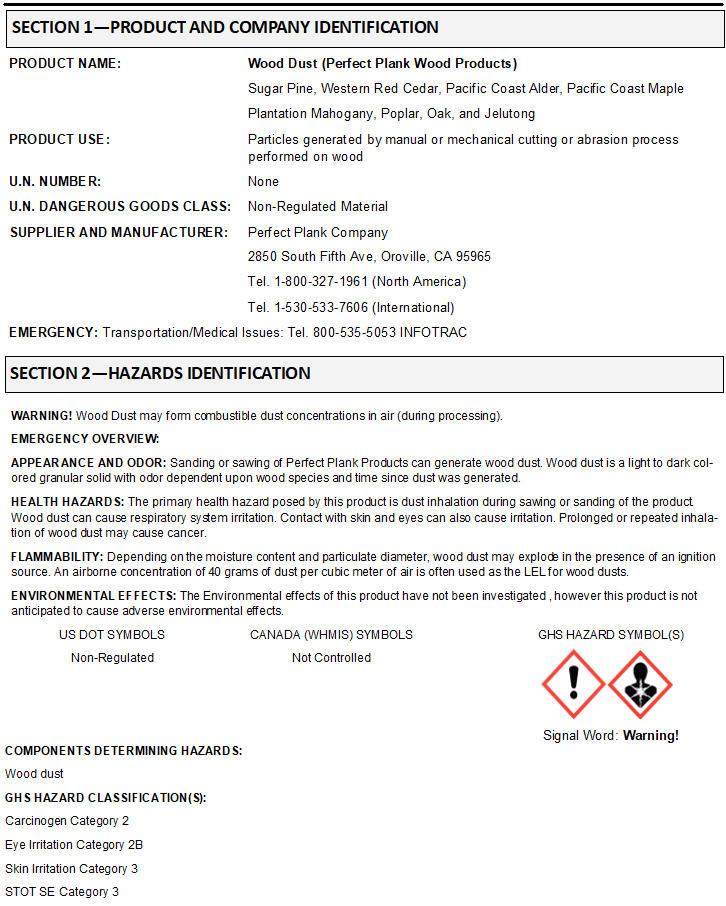
*****EMERGENCY OVERVIEW***** Caution: May cause
eye irritation
Potential Health
Effects. Primary Entry Routes: Skin Contact
or inhalation
Eyes:
Dust or splinters may cause irritation or injury to the eyes.
Skin: Contact
with skin may cause irritation
Inhalation: Dusts of this product may cause irritation
to the nose, throat or respiratory tract.
Ingestion: Highly unlikely,
but would result in irritation of the digestive tract if inhaled.
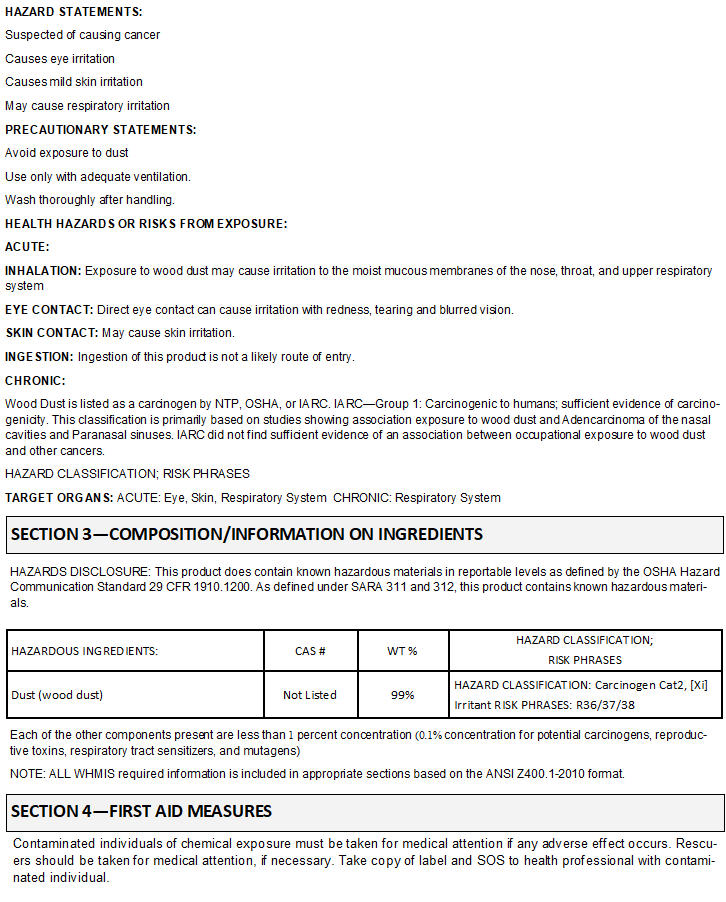
Section Four: First Aid Measures.
Inhalation: Remove
to fresh air. If breathing is labored, give oxygen and/or artificial respiration.
Eye Contact:
Immediately flush eyes with low-pressure water for 15 minutes. Obtain medical
attention if irritation persists.
Skin Contact: In case of irritation, flush with water.
Ingestion:
Not applicable
Section Five: Fire-Fighting Measures NFPA
Flash Point: Not Applicable 1
Auto-Ignition
Temperature: Variable with exposure to 212 degrees F or less
1 0
Explosive Limits in Air: 40 grams/M (LEL) --
Extinguishing
Media: Water, CO2, Sand
Special Fire-Fighting Procedures: Water to wet dust
and reduce likelihood
of ignition or
dispersion of dust into the air.
Unusual Fire and Explosion Hazard: Wood dust is strong
to severe explosion hazard if dust cloud contacts
an ignition source.
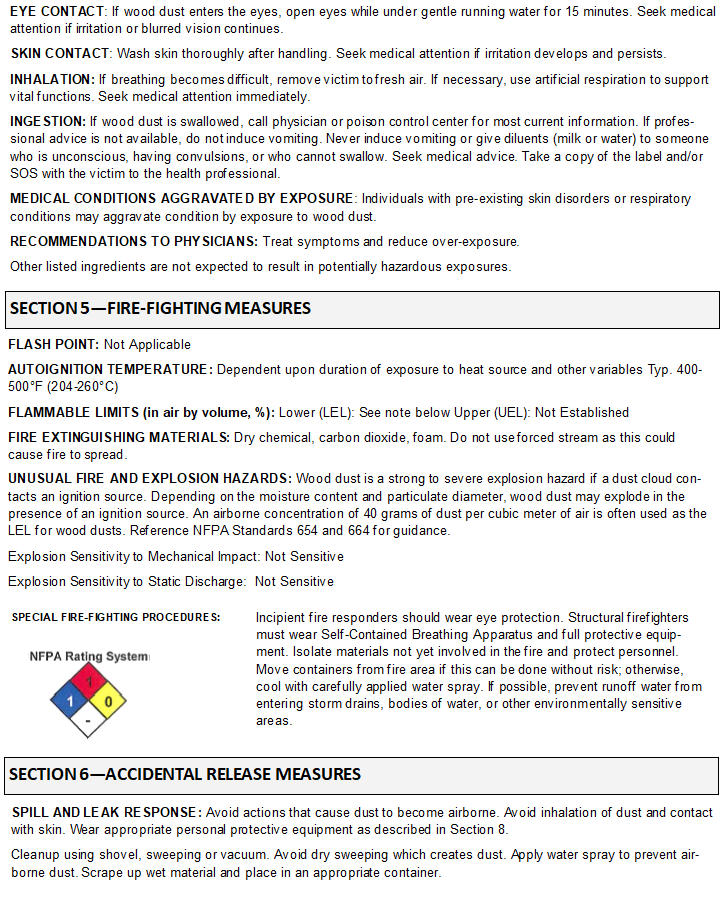
Section Six: Accidental Release Measures.
Spill/Leak Procedures: Sweep or vacuum spills. Avoid creating dust conditions.
Provide good ventilation where dust may accumulate. Place recovered wood dust in disposal containers.
Section Seven: Handling and Storage
Handling Precautions: Handle in accordance with traditional hygiene and safety practices.
These include the avoidance of unnecessary exposure to chips and dust from machine operation, paying particular attention
to protection of eyes, skin and clothing. Wash thoroughly after handling. Always use
appropriate Personal Protective Equipment (PPE).
Storage Requirements:
Store flat, supported and protected from contact with ground. Store in well- ventilated location
away from incompatible materials. Store in cool and dry location.
Section Eight:
Exposure Controls and Personal Protection. Engineering
Controls: Provide exhaust ventilation or other controls to prevent accumulation of airborne concentrations
of dust above the recommended exposure limits. Locate eye wash station near the work station.
Respiratory Protection: Dust mask.
Protective Clothing
and Equipment.
Hand Protection: Use impervious gloves.
Eye Protection: Use safety glasses equipped with side shields.
Safety Stations: Establish emergency eyewash stations and washing facilities.
General Hygiene Practice: Avoid breathing dust. Avoid contaminations of food,
beverages, or smoking materials. Wash thoroughly after handling and before eating, drinking or smoking.
Remove contaminated clothing promptly. Clean clothing thoroughly before re-use.
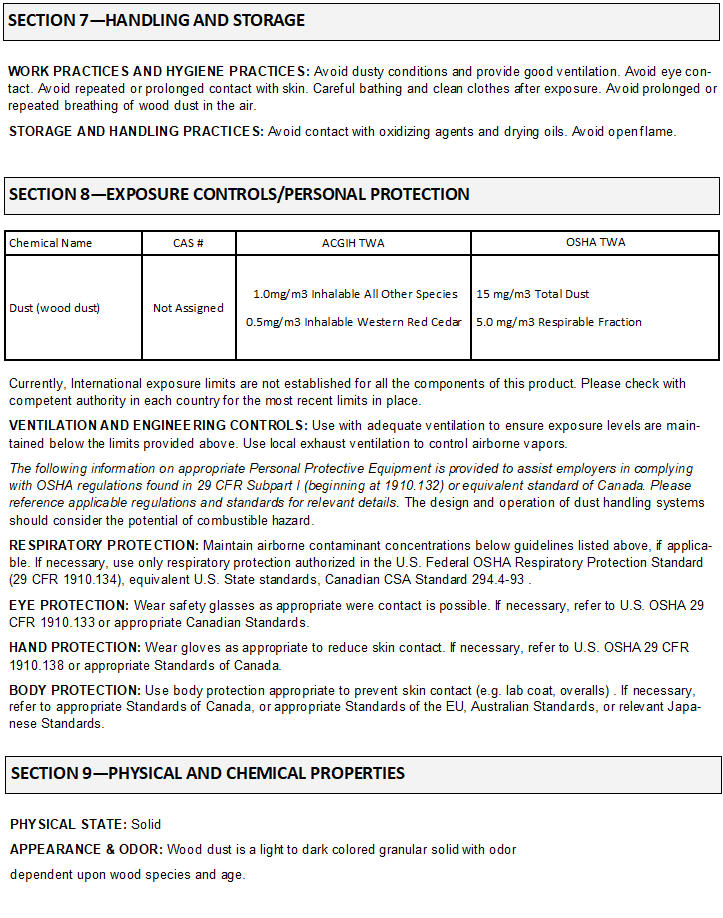
Section
Nine: Physical and Chemical Properties.
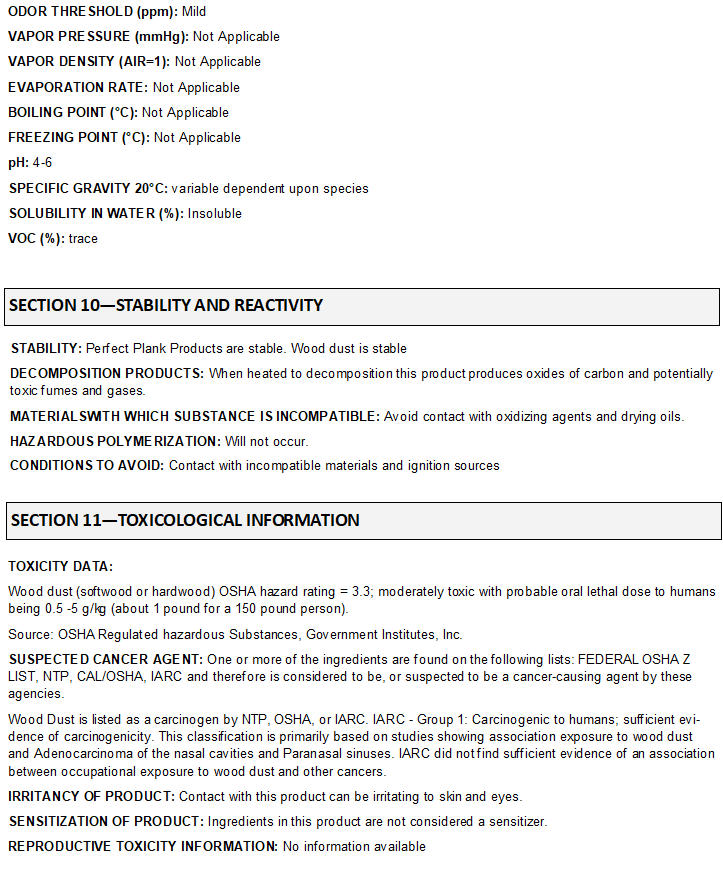
Appearance Light to dark colored solid.
Odor: Varies
with species. Odor Threshold: Not applicable.
Vapor Pressure: Not applicable. Vapor Density (Air=1). Not
applicable.
Specific Gravity (H20=1 at 4 degrees C): Variable, depending upon wood type.
pH: Not applicable.
Water Solubility:
Insoluble, although all species will absorb and emit moisture.
Section Ten: Stability and
Reactivity
Stability: Stable at room temperatures in closed containers under normal storage/handling conditions.
Polymerization: Hazardous polymerization will not occur.
Conditions to avoid: Heat and open flames.
Hazardous decomposition Products: Thermal oxidative decomposition can produce CO and CO2.
Section
Eleven: Toxicological Information.: Carcinogenicity IARC has classified
wood dust as a carcinogen to humans. (Group One). This classification is based primarily
on IARC’s evaluation of increased risk in the occurrence of adenocarcinomas of the nasal cavities and para nasal sinuses
associated with exposure to wood dust. IARC did not find sufficient evidence to associate cancers of the
oropharynx, hypopharynx, lung, lmphatic and hematopoietic systems, stomach, colon or rectum with exposure to wood dust.
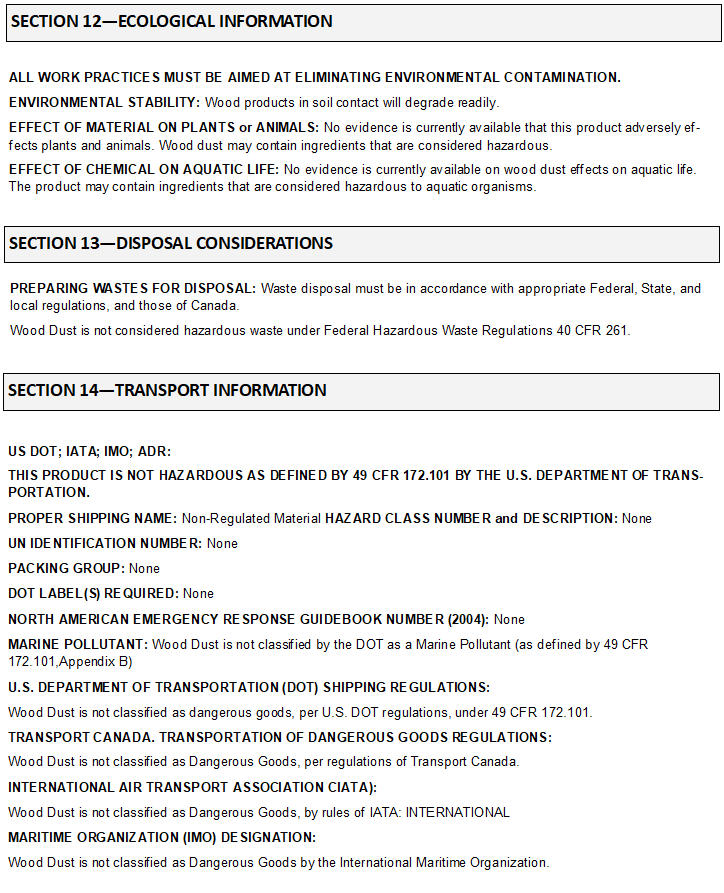
Section Twelve: Ecological Information. No known evidence of adverse effects.
Section
Thirteen: Disposal Considerations:
Use safety containers for disposal. Contact your supplies or a licensed contractor for detailed
recommendation. Follow applicable Federal state and local regulations.
Section Fourteen: Transportation Information:
DOT Transportation data (49CFR 172.101): Not regulated.
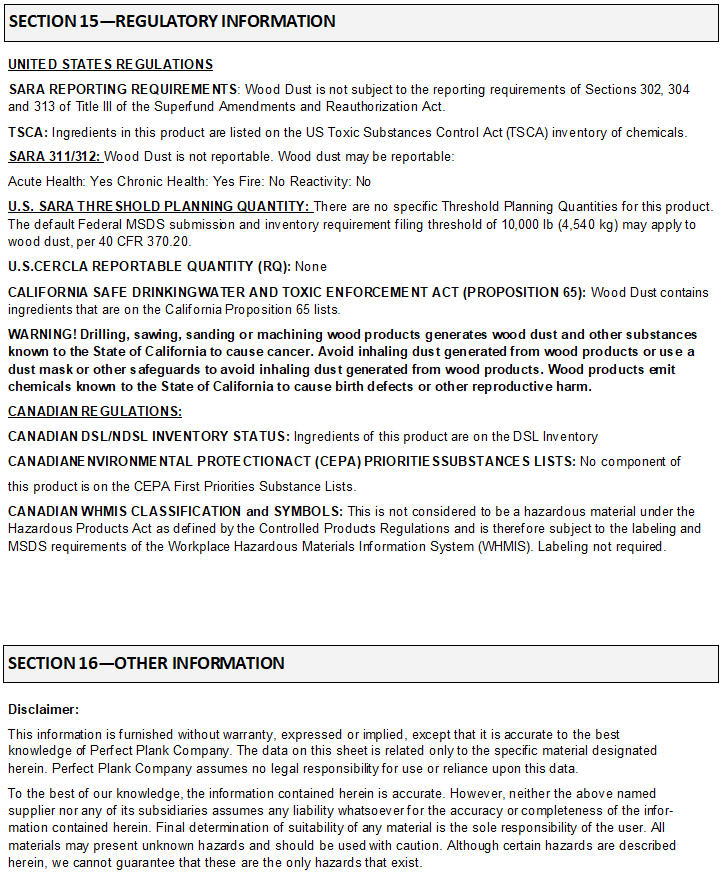
Section Fifteen. Regulator Information. US Federal Regulations:
RCRA Hazardous Waste Number: Not listed
(40 CFR 261.33)
RCRA Hazardous
Waste Classification (40 CFR 261.): Not classified
CERCLA Hazardous Substance (40 CFR 302.4) listed/unlisted specific per RCRA, Sec. 3001; CWA, Sec. 311
(b)(4); CWA, Sec. 307(a), CAA, Sec. 112: Not listed.
SARA 311/312 Codes: No hazard categories identified.
SARA Toxic Chemical (40 CFR 372.65): No components were identified
TSCA Inventory Status: All ingredients
listed on TSCA inventory requirements.
State Regulations: This product is
not known to contain any components for which the State of California has found tocause cancer, birth defects or other reproductive
harm.
Section Sixteen: Other Information. Disclaimer:
The following supersedes Buyer’s documents. SELLER MAKES NO REPRESENTATION OR WARRANTY, EXPRESSED OR IMPLIED, INCLUDING ANY WARRANTY OF MERCHANTABILITY OR FITNESS FOR A PARTICULAR
PURPOSE. No statements herein are to be construed as inducements to infringe any relevant patent. Under no circumstances shall
Seller be liable for incidental, consequential or indirect damages for alleged negligence, breach of warranty, strict of liability
arising in connection with the product(s). Buyer’s sole remedy and Seller’s sole liability for any claims shall
be Buyer’s purchase price. Data and results are based on controlled lab work and must be confirmed by Buyer by testing
for its intended conditions of use. The product(s) has not been tested for, and is therefore not recommended for, uses for
which prolonged contact with mucous membranes, abraded skin, or blood is intended; or for uses for which implantation within
the human body is intended.